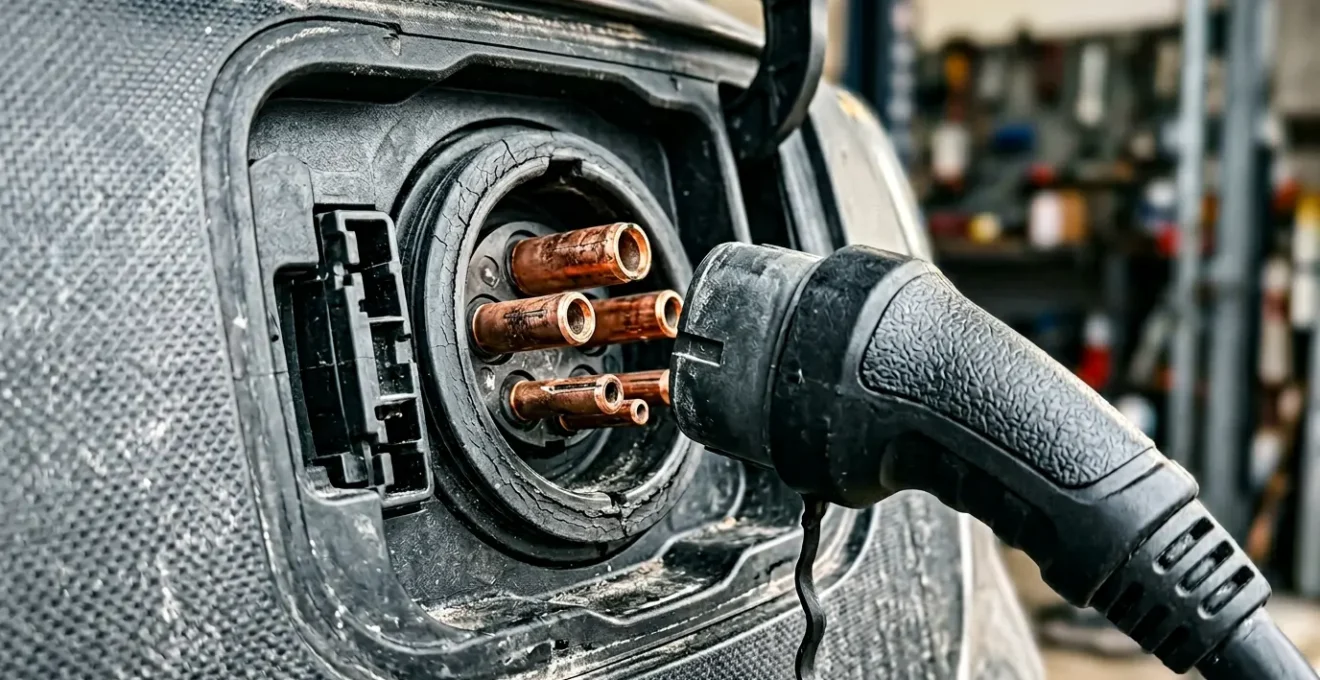
The biggest lie in EV marketing isn’t what they say; it’s what they leave out about the real costs of long-term ownership.
- Your car’s software is a liability that can cost you thousands in repairs or even void your warranty if not managed correctly.
- « Low-maintenance » parts like brakes and batteries hide expensive failure modes caused by neglect and thermal stress, not traditional wear and tear.
Recommendation: Stop thinking about maintenance in terms of oil changes and start thinking in terms of system health: thermal, software, and mechanical integrity.
The dream of electric vehicle ownership is seductive. No more gas stations, no more oil changes, just silent, effortless cruising. The marketing paints a picture of a nearly maintenance-free future, and for the first 50,000 miles, it often feels true. The focus is always on what’s absent: the engine, the exhaust, the transmission fluid. We’re told to celebrate the lack of traditional upkeep.
But as an experienced mechanic, I can tell you that what you’re not told is far more important. The real story of long-term EV ownership isn’t about the maintenance you skip, but the new, hidden costs you never saw coming. These costs aren’t born from wear and tear in the traditional sense; they arise from the complex interplay of software, specialized components, and the laws of physics that no marketing brochure can spin away. While the industry debates future technologies like battery swapping, the reality for today’s owners is grounded in managing the systems you already have.
This isn’t about scaring you away from EVs. It’s about arming you with the knowledge the dealership might not provide. We’re going to pull back the curtain on the three core areas where hidden costs accumulate: environmental impact on the battery, the paradox of « low-use » components, and the double-edged sword of software.
This guide delves into the practical, often overlooked, maintenance challenges that surface after the honeymoon period. By understanding these issues now, you can avoid costly surprises down the road. The following sections break down each of these hidden costs and provide actionable advice to protect your investment.
Summary: The Real Costs of Long-Term EV Maintenance
- Why Your EV Range Drops Faster in Cold Climates and How to Mitigate It?
- How to Maintain EV Brakes That Are Rarely Used Due to Regenerative Braking?
- Over-the-Air Updates: The Risk of Bricking Your Car If Interrupted
- Standard vs EV-Specific Tires: Is the Premium Price Worth the Mileage?
- When to Schedule a Coolant Flush for Your EV Battery System?
- Why Smart Home Energy Efficiency Upgrades Fail to Lower Bills for 40% of Homeowners?
- Connected Internet of Things Devices: The Security Flaw That Exposes 1 in 5 Smart Homes
- Why Smart Home Energy Efficiency Upgrades Fail to Lower Bills for 40% of Homeowners?
Why Your EV Range Drops Faster in Cold Climates and How to Mitigate It?
The first hidden cost isn’t a repair bill; it’s the loss of your car’s most valuable asset: its range. EV batteries are like people—they have a preferred temperature range. In the cold, the chemical reactions that produce electricity slow down, reducing efficiency. Compounding this, you turn on the cabin heater, which draws significant power. The result? A shocking range reduction that can leave you stranded. In fact, tests from the U.S. Department of Energy show a potential 50% range loss in urban driving at 0°F when using the heat.
This is where the type of heating system in your EV becomes a critical, often overlooked, feature. Older or cheaper EVs use resistive heaters, which are like giant toasters; they’re simple but incredibly inefficient. More modern or premium EVs use a heat pump. A heat pump works like an air conditioner in reverse, gathering ambient heat from outside (even in the cold) and moving it into the cabin. This is far more efficient.
The difference is not trivial. Research shows that heat pumps can reduce the power used for heating by 38% at 20°F. This translates directly into more range. The illustration below helps conceptualize the stark difference in thermal management approaches.

As you can see, the principle behind a heat pump is about intelligent energy transfer, not just brute-force energy creation. When buying an EV, especially in a cold climate, asking if it has a heat pump is one of the most important questions you can ask. To mitigate range loss, always precondition your car while it’s still plugged in. This uses wall power to heat the cabin and battery, preserving your precious range for the road.
Ultimately, managing your EV in the cold is the first lesson in understanding that EV ownership requires a new mindset—one focused on proactive energy management rather than reactive refueling.
How to Maintain EV Brakes That Are Rarely Used Due to Regenerative Braking?
Here’s one of the great paradoxes of EV maintenance. You’re told your brakes will last forever thanks to regenerative braking, which uses the electric motor to slow the car. It’s true that brake pads on an EV can last for an astonishing 70,000+ miles, with some exceeding 100,000 miles. What they don’t tell you is that the brake components can fail from *neglect*, not from use. This phenomenon is what I call « Silent Seizure. »
Your hydraulic brakes—the physical discs and calipers—are made of iron. When they sit unused, especially in humid or salty environments, they rust. On a conventional car, you use the brakes constantly, which scrapes this surface rust off. On an EV, where you might only use the physical brakes for a hard stop once a week, this rust builds up. The caliper pins can seize, the pads can rust to the caliper brackets, and the rotor surfaces can become pitted and uneven. The result? A perfectly good set of brake pads with 90% life left, but a seized and useless brake system that can cost hundreds or even thousands to repair.
This isn’t a defect; it’s a consequence of the technology. The hidden cost is the repair bill for a system that failed due to inactivity. The solution is simple but requires discipline: you must intentionally use your physical brakes to keep them healthy.
Your Quarterly EV Brake Health Routine
- Set regenerative braking to its lowest level or « off » to ensure you’re using the hydraulic brakes.
- Find a safe, empty road or parking lot where you can perform several stops without endangering others.
- Drive for 5-10 minutes, using only the brake pedal for all deceleration and stops to warm up the components.
- Perform 5 to 6 moderate stops from about 50 mph down to 10 mph. Don’t slam on them, but be firm.
- Allow about 30 seconds of driving between each stop to let the brakes cool and prevent overheating.
Performing this simple exercise once a season, or more often if you live in a coastal or winter-road-salt area, will burnish the rotors, move the caliper pins, and prevent the silent seizure that plagues overly babied EV brake systems. It feels counterintuitive to « waste » energy by turning off regen, but it’s cheap insurance against a major repair.
This simple procedure is a perfect example of the new EV maintenance mindset: it’s not about replacing worn parts, but about actively maintaining systems to prevent failure from disuse.
Over-the-Air Updates: The Risk of Bricking Your Car If Interrupted
Over-the-air (OTA) updates are marketed as a magical feature that makes your car better while you sleep. And often, they are. But they also represent a significant hidden risk: software as a liability. Unlike your phone, if a car’s software update fails, you can’t just walk to a store to get it fixed. A failed update can « brick » your car, rendering it an expensive, immobile sculpture in your driveway.
A failed update can be caused by anything from a weak Wi-Fi signal to a dip in the 12-volt battery’s voltage during the process. When it happens, the car’s essential control modules can lose communication, leading to a complete shutdown. The abstract technical process of an update is far more delicate than most owners realize.

This isn’t just a theoretical risk. It’s a real-world problem with significant costs, as seen in a well-documented incident with Rivian R1T trucks.
Case Study: The Rivian Update That Bricked Trucks
Multiple Rivian R1T owners reported their vehicles becoming completely unresponsive after a software update. The bug prevented the high-voltage and 12-volt batteries from communicating, draining the 12V battery and bricking the vehicle. While some repairs were covered by warranty, others were charged up to $1,000 for a new 12V battery—a part that was destroyed by a software flaw. This highlights the real financial risk owners bear when software updates cause hardware failures.
The hidden costs don’t stop at repair bills. Manufacturers are now tying your warranty to these updates. As General Motors states in its official warranty policy, you are now responsible for ensuring these updates are installed.
Failing to install an over-the-air software update within 45 days could cost you. Any damage linked to missed updates won’t be covered under warranty.
– General Motors Warranty Policy, GM U.S. warranty documents
Suddenly, that « convenient » update is a mandatory maintenance task with a deadline, and failure to comply could void your coverage for a related problem down the line. The takeaway is clear: treat OTA updates with respect. Ensure a strong Wi-Fi signal, a healthy 12V battery, and follow the on-screen instructions to the letter.
Software is no longer just a feature; it’s a core component of your vehicle’s health, and its maintenance is now your responsibility.
Standard vs EV-Specific Tires: Is the Premium Price Worth the Mileage?
Tires are the single most critical component for safety, yet in the EV world, they’re often discussed only in terms of one metric: range. EV-specific tires are engineered with harder rubber compounds to reduce rolling resistance, thereby maximizing how far you can go on a charge. They also have foam inserts to reduce road noise. This all comes at a significant price premium and, more importantly, a potential compromise in other areas.
The hidden cost here is a complex one: the efficiency trade-off. By optimizing for low rolling resistance, are you giving up performance where it matters most, like wet-weather braking? A standard, high-quality « summer » or « all-season » tire is designed for a balanced performance, prioritizing grip and handling. An EV tire prioritizes efficiency above all else. As a mechanic, I always tell people to look at the whole picture, not just the single number the marketing department wants you to see.
The following table, based on independent testing data, illustrates this trade-off perfectly. It compares several EV-specific tires against a top-tier standard tire (the Continental PremiumContact 7).
| Tire Model | Rolling Resistance (kg/t) | Calculated Range (km) | Wet Braking Distance (m) | Price Category |
|---|---|---|---|---|
| Falken e.Ziex (EV-specific) | 5.86 | 410 | 40.4 | Mid-range |
| Hankook iON evo (EV-specific) | 6.81 | 381.3 | 39.6 | Premium |
| Michelin e.Primacy | 6.54 | 387.9 | 40.3 | Premium |
| Continental PremiumContact 7 (Standard) | 7.66 | 344.4 | 39.4 | Premium |
Look closely at this recent comparative analysis. The standard Continental tire has the worst range by a significant margin—a loss of over 65 km compared to the most efficient EV tire. However, its wet braking distance (39.4m) is the best of the group. It stops shorter in the rain than any of the expensive, « specially designed » EV tires. So, is an extra 40-60 km of range worth an extra meter or more of braking distance in an emergency? That’s a decision you have to make, but it’s a hidden compromise you need to be aware of. The premium price for EV tires doesn’t just buy you range; it might also be buying you a reduced safety margin in certain conditions.
Before you automatically replace your tires with the manufacturer’s expensive EV-specific model, consider your priorities. If you live in a rainy climate and mostly do short trips, a high-quality standard tire might be a safer and more cost-effective choice.
When to Schedule a Coolant Flush for Your EV Battery System?
Of all the hidden costs, this is the big one—the monster lurking under the floor of your car. Your EV’s battery has a thermal management system, a network of channels filled with a special coolant that keeps the cells at their optimal temperature. This system is the single most important factor in your battery’s long-term health and longevity. If it fails, the consequences are catastrophic. The National Highway Safety Administration warns that if the battery pack needs to be replaced, it can cost between $10,000 to $20,000.
The hidden cost is what I call « Thermal Debt. » Every time the battery gets too hot or too cold because the cooling system isn’t performing perfectly, it accrues a tiny bit of irreversible damage. This debt is invisible for years, showing no symptoms. The coolant degrades over time, losing its thermal transfer properties. Small, undetected leaks can lower the fluid level. The problem is, most owners never think about it because it’s not on any traditional maintenance schedule. They assume it’s a « sealed for life » system.
There is no such thing as « sealed for life. » Eventually, that thermal debt comes due. The battery management system (BMS) starts throwing errors as cells degrade, or in the worst-case scenario, the pack fails entirely. We’ve seen cases where degraded coolant management was suspected in Tesla vehicles leading to BMS errors and owners facing replacement bills of up to $15,000. It’s a silent killer of your car’s biggest asset.
So, when do you service it? This is where you need to be a proactive owner. Consult your vehicle’s specific maintenance schedule. Some manufacturers, like Tesla, claim the coolant lasts the life of the car, while others, like Chevrolet, recommend a flush every 5 years or 150,000 miles. My advice? Don’t push it. If your manufacturer gives a service interval, adhere to it strictly. If they don’t, I recommend having the system inspected and the coolant quality tested every 3-4 years after the warranty expires. A coolant flush costing a few hundred dollars is the best insurance you can buy against a five-figure battery replacement bill.
Ignoring this one « hidden » fluid could be the most expensive mistake an EV owner can make.
Why Smart Home Energy Efficiency Upgrades Fail to Lower Bills for 40% of Homeowners?
This headline about smart homes holds a crucial lesson for EV owners: chasing a single efficiency metric while ignoring the whole system is a recipe for financial disappointment. For homeowners, it might be installing smart thermostats but having leaky windows. For an EV owner, the equivalent is obsessing over the battery’s EPA-rated range while ignoring the real-world energy ecosystem that determines your actual cost per mile.
Your EV’s efficiency isn’t a fixed number; it’s a dynamic system influenced by three key factors you control:
- Charging Habits: Constantly fast-charging to 100% is like redlining an engine every day. It’s hard on the battery and less efficient than slower AC charging at home, which generates less heat. The cheapest and healthiest electrons are the ones you put in slowly overnight, scheduled for off-peak rates.
- Driving Style: The ‘E’ in EV might as well stand for ‘Energy’. Aggressive acceleration and hard braking (overriding regen) consume massive amounts of power. A smooth, anticipatory driving style can improve your efficiency by 15-30%, which is like getting a 15-30% discount on your « fuel » cost.
- Ancillary Usage: Just like a smart home has phantom power draws, your EV does too. Running the heat or AC on full blast, as we’ve seen, is a major drain. But even things like having Sentry Mode active 24/7 can consume a noticeable amount of energy over a week, adding to your electricity bill.
The hidden cost is the delta between the « advertised » efficiency and your « actual » efficiency. You can have the most efficient EV on the market, but if your charging, driving, and usage habits are poor, you’ll be one of those owners wondering why your electricity bill hasn’t dropped as much as you expected. The solution is a holistic approach: charge smart, drive smooth, and be mindful of your energy consumption.
Treating your car as a complete energy system, rather than just a machine with a big battery, is the key to truly realizing the economic benefits of going electric.
Connected Internet of Things Devices: The Security Flaw That Exposes 1 in 5 Smart Homes
Your car is the most sophisticated, and potentially vulnerable, Internet of Things (IoT) device you own. That headline about smart home security flaws should be a sobering warning for every connected car owner. The risks we see in a compromised smart speaker or thermostat are a playground compared to the potential for malice in a two-ton vehicle that’s connected to the internet.
The conversation around OTA updates often focuses on the risk of accidental « bricking, » but the security dimension is an equally significant hidden cost. The « cost » here is one of risk and vulnerability. Every connection point is a potential door for a bad actor. This includes:
- Your Home Wi-Fi: Most major updates are downloaded via Wi-Fi. If your home network has a weak password or outdated router firmware, it’s theoretically possible for an attacker on your network to interfere with the download, potentially corrupting the update file.
- The Cellular Connection: The car’s own modem is another entry point. While manufacturers spend millions on securing this, no system is impenetrable.
- The Smartphone App: The app that lets you unlock your doors and check your charge is a powerful key. If your phone is compromised or you fall for a phishing attack related to your car’s brand, an attacker could gain control.
The immediate financial cost could be a ransomware attack demanding payment to unlock your car, or the theft of personal data stored in the vehicle’s infotainment system. The long-term cost is the potential for an attacker to install malicious code that could affect the vehicle’s operation down the line. While large-scale hacks are rare, they are not impossible. As a mechanic, my advice is to practice good digital hygiene with your car just as you would with your bank account. Use strong, unique passwords for your car’s app and your home Wi-Fi, be skeptical of unsolicited emails, and keep your phone’s operating system updated.
You wouldn’t leave your house keys lying around; don’t leave your car’s digital keys unprotected either.
Key Takeaways
- EV maintenance is about preventing systemic failures (thermal, software), not just replacing parts.
- « Low-use » doesn’t mean « no-maintenance. » Inactive components like brakes require specific procedures to avoid costly seizure.
- Software updates are a mandatory maintenance task with financial risks; treat them with caution and understand your warranty.
Why Smart Home Energy Efficiency Upgrades Fail to Lower Bills for 40% of Homeowners?
That second smart home headline isn’t a typo; it’s a powerful reminder that misinterpreting the numbers leads to costly mistakes. For EV owners, the ultimate « hidden bill » comes from misunderstanding the difference between your battery’s State of Charge (SoC) and its State of Health (SoH). The two are fundamentally different, and confusing them can cost you everything.
State of Charge (SoC) is what you see on your dashboard every day. It’s the « gas gauge, » showing you that your battery is 90% full. It’s a temporary, fluctuating number. It tells you how much energy is available right now.
State of Health (SoH) is the number they don’t show you. It represents the battery’s total capacity to store energy compared to when it was new. A battery with 90% SoH, when fully charged to 100% SoC, can only hold 90% of the energy it could when it rolled off the factory line. This is the measure of permanent degradation, and it only goes in one direction: down.
This is the final, and most profound, hidden cost. All the issues we’ve discussed—extreme temperatures, inefficient cooling, and constant fast-charging—contribute to the decline of your SoH. It’s the physical manifestation of your accrued « Thermal Debt. » You don’t get a monthly bill for SoH loss. You get a single, massive bill when the battery’s health degrades to a point where the range is no longer usable, and you’re facing that $15,000 replacement. This is why a used EV with low mileage but a history of being fast-charged in a hot climate can be a worse value than a higher-mileage EV that was charged slowly in a moderate climate.
The ultimate goal of a savvy EV owner is not just to keep the battery charged, but to preserve its health. By mitigating the hidden costs of thermal stress, component neglect, and software risks, what you are really doing is protecting your battery’s SoH—and saving yourself from the biggest repair bill in the automotive world.