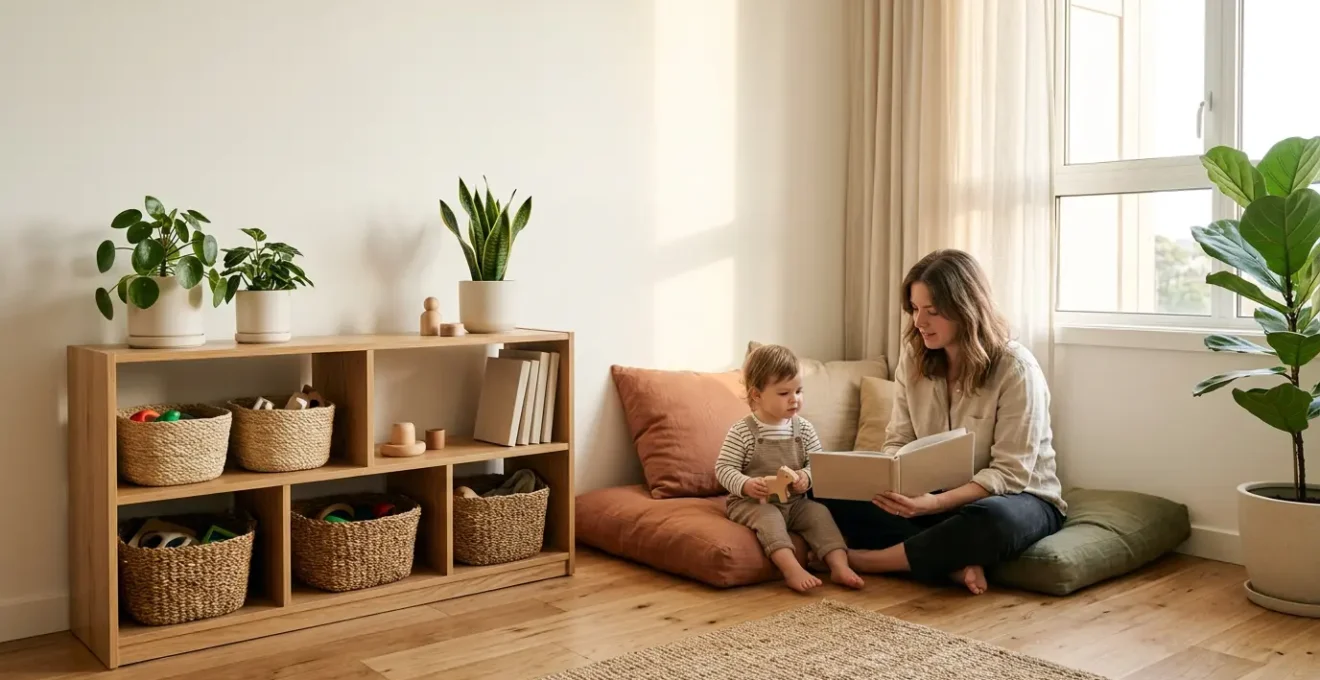
The secret to a calm family home isn’t more storage; it’s consciously curating your apartment’s sensory inputs to lower stress hormones for everyone inside.
- Constant visual clutter and noise in open-plan layouts can elevate parental cortisol levels, impacting health and well-being.
- Strategic control of light (using warm bulbs) and sound (through soft furnishings) directly influences a child’s ability to calm down and sleep.
Recommendation: Start by changing one light bulb in the living area to a warm, dimmable 2700K bulb and observe the change in the evening mood for one week.
For the parent living in a compact urban apartment, the feeling of being overwhelmed is a familiar guest. The constant hum of the city outside and the vibrant chaos of family life inside can feel like a sensory assault. Every surface seems covered in toys, every sound echoes, and the line between a personal retreat and a shared playroom blurs into non-existence. The common advice—declutter, buy multi-functional furniture—often feels like applying a band-aid to a deeper issue. It treats the symptom, the clutter, but ignores the root cause: an environment that overstimulates the nervous system.
This guide takes a different approach, one rooted in interior psychology. We will explore how your living space directly communicates with your brain and body, influencing everything from stress levels to sleep quality. What if the solution wasn’t about hiding the evidence of family life, but about transforming your home into a tool for co-regulation? The key isn’t to create a sterile, minimalist box, but a sensory-aware sanctuary that supports the well-being of both you and your children.
We’ll move beyond simple organization tips to delve into the science of environmental stress. We will uncover how specific choices in lighting, acoustics, and spatial boundaries can actively reduce cortisol, promote melatonin production, and create the pockets of peace you crave. By understanding the ‘why’ behind the ‘how,’ you can make intentional design choices that turn your small apartment from a source of stress into a haven of harmony.
This article provides a complete roadmap, grounded in psychology and practical design, to help you reclaim your space and your calm. Explore the sections below to understand and implement these transformative strategies.
Summary: A Psychologist’s Framework for a Serene Family Apartment
- Why Open-Plan Living Increases Cortisol Levels in Young Parents?
- How to Soundproof a Nursery Without Renovating Rental Walls?
- Warm vs Cool Light: Which Bulbs Help Toddlers Calm Down Before Bed?
- The Toy Rotation Mistake That Makes Your Living Room Look Like a Daycare
- When to Reclaim Your Bedroom: Establishing Boundaries With Co-Sleeping Kids
- Improving Sleep Patterns: The Bedroom Setup That Cures Insomnia for Light Sleepers
- Modular Ergonomic Furniture: Which System Adapts Best to a Growing Child’s Spine?
- Screen-Free Parenting Activities: How to Engage a Bored 5-Year-Old for 60 Minutes?
Why Open-Plan Living Increases Cortisol Levels in Young Parents?
The modern ideal of open-plan living, celebrated for its sense of space and light, carries a hidden psychological cost for parents of young children. In a small apartment, the absence of walls means there is no escape from sensory input. The sounds of playing, the sight of scattered toys, and the constant motion are not just minor annoyances; they are persistent environmental stressors. Your brain processes this constant « visual noise » as a long list of unfinished tasks, creating a low-grade, chronic state of alert.
This isn’t just a feeling; it’s a physiological reality. Your body responds to this persistent, low-level chaos by altering its production of cortisol, the primary stress hormone. Ideally, cortisol levels peak in the morning to wake you up and gradually decline throughout the day. However, constant environmental stress can disrupt this natural rhythm. In fact, research confirms that for parents, a home perceived as cluttered and chaotic is linked to a flatter diurnal cortisol slope—a pattern associated with chronic stress and an increased risk of adverse health outcomes. This means your body fails to « power down » in the evening, making it harder to relax, rest, and recover.
The issue isn’t the open plan itself, but the lack of sensory boundaries. Without physical separation, every zone bleeds into the next. The dining table becomes a craft station, the sofa a fortress, and the parent’s line of sight is a constant panorama of activity and clutter. This lack of defined zones prevents the mind from switching off, creating a feeling of being perpetually « on duty. » Understanding this connection between your environment and your hormonal response is the first step toward designing a home that calms the nervous system instead of activating it.
How to Soundproof a Nursery Without Renovating Rental Walls?
In a compact apartment, sound is a fluid entity, seeping under doors, through walls, and around windows. For a parent, this means every cough from the nursery can jolt you awake, and every late-night conversation risks disturbing your child. Creating an auditory cocoon for your child (and yourself) is essential for restorative sleep, but major renovations are rarely an option in a rental. The solution lies in layering and absorption, using renter-friendly materials to dampen and block sound transmission.
The key principle is to add mass and density. Sound travels through vibrations, so your goal is to interrupt its path. Heavy, dense materials are excellent at this. Think beyond flimsy foam panels and consider functional items that pull double duty. A fully stocked bookshelf placed against a shared wall is one of the most effective, non-destructive sound barriers. The varied mass of books, papers, and decorative objects works to break up and absorb sound waves far more effectively than an empty wall.
Here is a view of how to use existing furniture to create a sound barrier.

As this image demonstrates, texture and density are your allies. Don’t overlook the gaps. A surprising amount of noise leaks through the space under a door or around a window frame. Simple additions like a door sweep and high-quality weatherstripping can make a significant difference. For windows, heavy, multi-layered thermal curtains not only block light but also offer substantial sound-dampening properties. For a more targeted approach, acoustic panels cleverly disguised as wall art can absorb ambient noise within a room, reducing echo and creating a calmer atmosphere without a single nail.
These strategies are effective because they address the physics of sound without altering the structure of your home. They are about adding layers of absorption and blocking the paths of least resistance, allowing you to create zones of quiet for restful sleep.
Warm vs Cool Light: Which Bulbs Help Toddlers Calm Down Before Bed?
Light is one of the most powerful, yet often overlooked, tools for regulating your family’s internal clocks. The color and intensity of the light in your home sends direct signals to the brain, telling it when to be alert and when to wind down. For toddlers and preschoolers, whose systems are exceptionally sensitive, this effect is magnified. Using the wrong type of light in the evening can actively sabotage your bedtime routine by suppressing the production of melatonin, the hormone of sleep.
The culprit is often the bright, cool-toned light (above 3500K) found in many standard LED bulbs. This blue-spectrum light mimics daylight, signaling to the brain that it’s time for activity. This is helpful in the morning but disastrous before bed. In fact, research on preschool light sensitivity shows that even low-level light exposure in the evening can suppress melatonin by an average of 77.5%. The solution is to create a « digital sunset » inside your apartment by switching to warm, amber-toned light (under 2700K) in the hours leading up to bedtime. This mimics the natural transition to night and allows your child’s brain to begin producing melatonin uninhibited.
Implementing a strategic lighting schedule is a simple yet profound way to support your child’s circadian rhythm. A dedicated lighting plan, as detailed in the table below based on recommendations from sleep experts, can guide this transition from active day to calm night.
| Time Period | Recommended Color Temperature | Recommended Brightness | Purpose |
|---|---|---|---|
| Activity Time (Morning-Afternoon) | 3500-4500K (Cool/Neutral White) | >800 lumens | Promotes alertness and daytime activity |
| Calm-Down Hour (Pre-Dinner) | 2700K (Warm White) | ~400 lumens | Begins transition to evening mode |
| Pre-Sleep Ritual (60-90 min before bed) | <2200K (Amber/Warm) | <150 lumens | Maximizes melatonin production |
| Nightlight (if needed) | Red or Amber | Minimal (<5 lux) | Least disruptive to sleep hormone |
This isn’t about creating a dark cave. It’s about using light intentionally. By dimming the lights and shifting to warmer tones an hour or two before bed, you’re not just changing the ambiance; you’re engaging in a form of biological communication, gently guiding your child’s nervous system toward a state of rest. It’s a powerful, non-verbal cue that the day is ending and it is time for sleep.
The Toy Rotation Mistake That Makes Your Living Room Look Like a Daycare
The most common approach to toy clutter is a frantic, end-of-day cleanup that leaves you exhausted and your living room looking like a brightly colored storage unit. The critical mistake is focusing on *storage* instead of *curation*. When a child is presented with dozens of toys at once, they experience sensory overload. Instead of engaging in deep play, they flit from one item to the next, creating more mess and less genuine engagement. This is the visual equivalent of the open-plan stressor: a landscape of overstimulation for both child and parent.
A more effective strategy is a disciplined toy rotation system, a cornerstone of Montessori philosophy. This involves dramatically reducing the number of toys available at any given time—typically to just 8-10 well-chosen items. The rest are stored out of sight. This simple act has a profound psychological effect. It reduces visual noise, making the space feel instantly calmer. For the child, fewer choices lead to deeper, more creative play and a greater appreciation for each item. When a « new » set of toys is rotated in, it’s met with the excitement of novelty.
Case Study: The 8-Toy Rule in Action
A family struggling with a perpetually messy playroom implemented a strict Montessori toy rotation, reducing the accessible toys from over 50 to just 8 activities displayed on a low shelf. The rest were stored in bins in a closet. They rotated the selection every Sunday evening. The results were immediate: the child, previously distractible, began spending up to 30 minutes focused on a single puzzle. The daily cleanup took less than five minutes. Most importantly, toys that had been ignored for months became sources of intense excitement when they were reintroduced into the rotation.
The goal is aesthetic integration—choosing storage solutions that blend seamlessly with your adult decor. Think natural woven baskets, simple wooden crates, or canvas bins on a low shelf. This approach respects the child’s need for access while honoring the parent’s need for a serene living space.
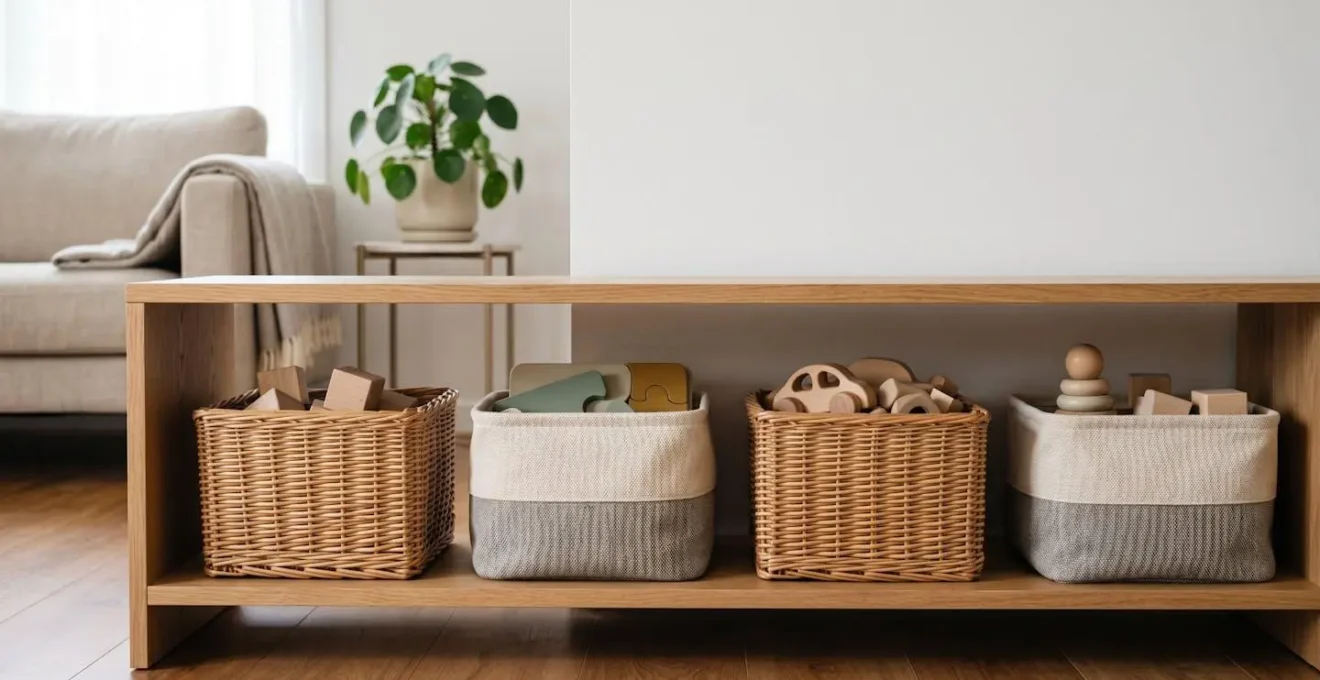
This isn’t about deprivation; it’s about intention. By curating your child’s play environment, you not only reclaim your living room’s aesthetic but also foster better focus and creativity in your child. You transform a source of daily friction into a system of calm, predictable order.
When to Reclaim Your Bedroom: Establishing Boundaries With Co-Sleeping Kids
For many families in small apartments, co-sleeping begins as a practical solution for nighttime feeds and comfort. However, it can evolve into a situation where the parental bedroom no longer feels like a personal sanctuary. The lack of a distinct, adult-only space can be a significant contributor to parental stress and sleep deprivation. Reclaiming your bedroom is not about rejecting your child; it’s about re-establishing necessary spatial and psychological boundaries that are crucial for your own rest and identity as an adult.
The transition from co-sleeping to independent sleeping can be fraught with anxiety for both parent and child. A sudden change can feel like an abandonment. The key is a gradual, gentle retreat that respects the child’s need for security while progressively creating physical distance. This method allows the child to adapt in small, manageable steps, reducing tears and nighttime battles. It’s a process that builds confidence rather than creating fear, making the child an active participant in gaining their own sleep independence.
Rather than an abrupt move, this process involves a series of small, incremental shifts. The goal is to make each step so minor that it barely registers, allowing you to move forward at a pace that feels comfortable for your family. If a step proves too challenging, you can easily revert to the previous one for a few nights before trying again. This removes the pressure and sense of failure, turning the transition into a patient, collaborative effort.
Your Action Plan: The Gradual Retreat Method
- Spatial Boundary: Move the child to a floor bed or mattress within your bedroom, maintaining proximity while creating a separate sleep surface.
- Incremental Shift: Over several nights, gradually move their bed a little closer to the doorway, increasing the distance from your own bed.
- Threshold Position: Position the child’s bed just outside your bedroom door, leaving the door slightly ajar to maintain auditory connection.
- Room Transition: Once comfortable, complete the move to their own room, ensuring the familiar bedtime routine remains consistent and comforting.
- Core Principle: Make each step small and reversible. This approach minimizes anxiety by empowering both parent and child throughout the process.
This methodical approach transforms a potentially stressful milestone into a predictable and secure process. It’s a powerful way to teach your child about personal space while reclaiming your bedroom as a vital sanctuary for adult rest and connection.
Improving Sleep Patterns: The Bedroom Setup That Cures Insomnia for Light Sleepers
For a parent, especially a light sleeper, the bedroom should be the ultimate sanctuary—a place for deep, restorative rest. However, in a small apartment, ambient light from the street, noise from neighbors, and a mind that won’t switch off can make quality sleep feel like an impossible luxury. Curing this « parental insomnia » requires moving beyond basic sleep hygiene and constructing a multi-layered sensory cocoon designed to shield you from every possible disruption.
This approach addresses the three main sensory pathways that disrupt sleep: light, sound, and touch. It’s about creating an environment of absolute sensory deprivation, signaling to your overstimulated brain that it is finally safe to power down completely. This isn’t just about comfort; it’s about systematically eliminating the external cues that keep your nervous system on high alert. Many parents find that even with a good routine, their sleep is shallow and easily broken, a classic sign of an environment that isn’t optimized for deep rest.
Case Study: The Three-Pronged Sensory Cocoon
Sleep researchers advocate for a comprehensive approach for parents struggling with light sleep. This involves: (1) Total light blocking, using not just blackout curtains but also adhesive light-blocking strips to seal the tiny gaps around window edges that let in ambient light. (2) Sound isolation, achieved with high-quality earplugs or specialized sleep headbands with flat speakers for playing white noise. (3) Tactile comfort and security, using the gentle, steady pressure of a weighted blanket to calm the nervous system and a cooling mattress topper to regulate body temperature, preventing overheating which can disrupt sleep cycles.
This multi-sensory strategy works because it acknowledges that parental sleep is fragile. It’s not enough to solve just one problem. You need to create a fortress of tranquility. As sleep researchers from the University of Colorado Boulder emphasize, consistency is just as important as the environment itself. In their evidence-based recommendations for families, they state:
Maintain a consistent bedtime without big differences across weekdays and weekends. Establish a calm and consistent pre-bedtime routine. Turn off screens and media devices at least one hour before bedtime. Reduce light levels in the home at least one hour before bedtime.
– University of Colorado Boulder Sleep Researchers, Evidence-Based Sleep Recommendations for Families
By combining a rigorously controlled sensory environment with an unwavering routine, you give your body and mind the clearest possible signals for rest. You are not just hoping for sleep; you are actively engineering the conditions for it.
Modular Ergonomic Furniture: Which System Adapts Best to a Growing Child’s Spine?
In a small apartment, every piece of furniture must earn its place. For families, this means choosing items that are not only space-efficient but also adaptable to a child’s rapid growth and changing needs. Modular, ergonomic furniture is an investment in both harmony and health. It reduces clutter by serving multiple functions over many years, and it supports your child’s physical development by adapting to their body, rather than forcing their body to adapt to it. This is about future-proofing your home and preventing long-term physical strain.
The best modular systems are designed to solve specific parental friction points. These are the small, daily irritations that accumulate into significant stress: the bulky high chair that’s always in the way, the mountain of plastic toys that have no home, the constant need to buy new furniture as your child outgrows the old. By selecting furniture that evolves, you design these friction points out of your daily life. An adjustable chair that pulls up to the main table eliminates the separate high chair. A storage system that doubles as a play surface contains the chaos. A desk that grows with your child ensures they always have a comfortable space for homework and creativity.
The key is to think in terms of lifespan and transformation. Before buying any item, ask: What will this be in five years? Can it adapt from a toddler’s need to a school-aged child’s, and then to a teenager’s or an adult’s? This long-term perspective shifts the focus from temporary fixes to sustainable, ergonomic solutions that respect both your budget and your child’s developing spine. This comparative analysis highlights systems that excel in adaptability.
| System Type | Parent Friction Point Solved | Child Independence Feature | Future-Proofing Benefit |
|---|---|---|---|
| Stokke Tripp Trapp Chair | Eliminates separate high chair (saves space + reduces clean-up zones) | Adjustable height allows child to sit at main table independently | Converts to adult dining chair; 10+ year lifespan |
| LEGO x IKEA BYGGLEK System | Integrated toy storage with display (reduces visible clutter) | 5-year-old can build, display, and tidy independently | Modular boxes repurpose as office/hobby storage |
| Montessori Low Shelving (e.g., IKEA KALLAX modified) | Quick height adjustments with removable shelves (adapts to growth spurts) | Everything at child’s reach promotes self-selection and clean-up | Transforms into media console, home office unit, or entryway storage |
| Convertible Desk Systems | Wipe-clean surfaces for messy activities (low friction maintenance) | Adjustable desk height grows with child for homework independence | Becomes adult workspace or craft station |
Choosing furniture becomes a strategic act of environmental design. You are not just filling space; you are investing in pieces that promote independence, reduce your workload, and provide correct ergonomic support throughout childhood. This is how you create a home that works for you, not against you.
Key Takeaways
- Your home environment directly impacts stress hormones; visual clutter and constant noise can lead to elevated cortisol.
- Regulate your family’s sleep cycles by using warm, dim light in the evening and ensuring total darkness in bedrooms.
- Control visual noise and foster deep play by implementing a toy rotation system with aesthetically pleasing storage.
Screen-Free Parenting Activities: How to Engage a Bored 5-Year-Old for 60 Minutes?
One of the biggest challenges in a small space is finding engaging, screen-free activities that can hold a child’s attention long enough for a parent to catch their breath. The goal isn’t just to keep them busy, but to provide rich, sensory engagement that fosters independence and creativity. The best activities are often simple, using everyday items to transform a small space into a world of possibility. They work by creating a contained experience that is novel, challenging, and easy to clean up—a trifecta for parental sanity.
The secret is to reframe your apartment’s limitations as creative constraints. The bathtub isn’t just for washing; it’s a contained « sensory lab » for potion-making with food coloring or an « ice excavation » site for frozen toys. This minimizes mess and makes cleanup a simple matter of pulling the drain plug. Similarly, chores can be gamified into « quests. » A « Sock-Matching Quest » or a « Dust Bunny Hunt » not only engages a child but also subtly outsources a bit of the household workload, turning a source of parental stress into a moment of shared play.
Creating dedicated « kits » for high-engagement activities is another powerful strategy. A « fort kit » with lightweight fabrics and clamps, stored in a flat bag under the sofa, turns the setup and takedown into part of the fun. An audio story paired with a « build challenge » (using LEGOs or drawing materials) encourages quiet, independent focus while allowing the parent to be present but not actively participating. These activities are designed to have a clear beginning, middle, and end, fitting neatly into a 60-minute window and providing the parent with a predictable pocket of downtime.
- Bathtub Sensory Lab: Fill the tub with a few inches of water and provide tools for « potion making » (food coloring, soap) or « excavation » (small toys frozen in ice blocks). The mess is perfectly contained for stress-free cleanup.
- Dedicated Fort Kit: Keep lightweight fabrics, clamps, and suction cups in a designated bag. The act of building and deconstructing the fort becomes a lesson in spatial problem-solving.
- Task-Based Adventure Games: Transform chores into missions. A « Sock-Matching Quest » or a « Silverware Sorting Factory » engages the child in household tasks, reducing the parent’s workload.
- Audio Story + Build Challenge: Play an age-appropriate podcast and challenge your child to build or draw what they hear. This fosters quiet, creative focus and independent play.
By curating these high-engagement, low-friction activities, you are not just distracting your child. You are teaching them how to engage in deep, independent play, a skill that is foundational for creativity and self-regulation. And in doing so, you carve out the invaluable time you need to recharge your own batteries.
Now that you are equipped with these strategies, the next step is to begin implementing them, one small change at a time, to transform your apartment into the sanctuary you and your family deserve.