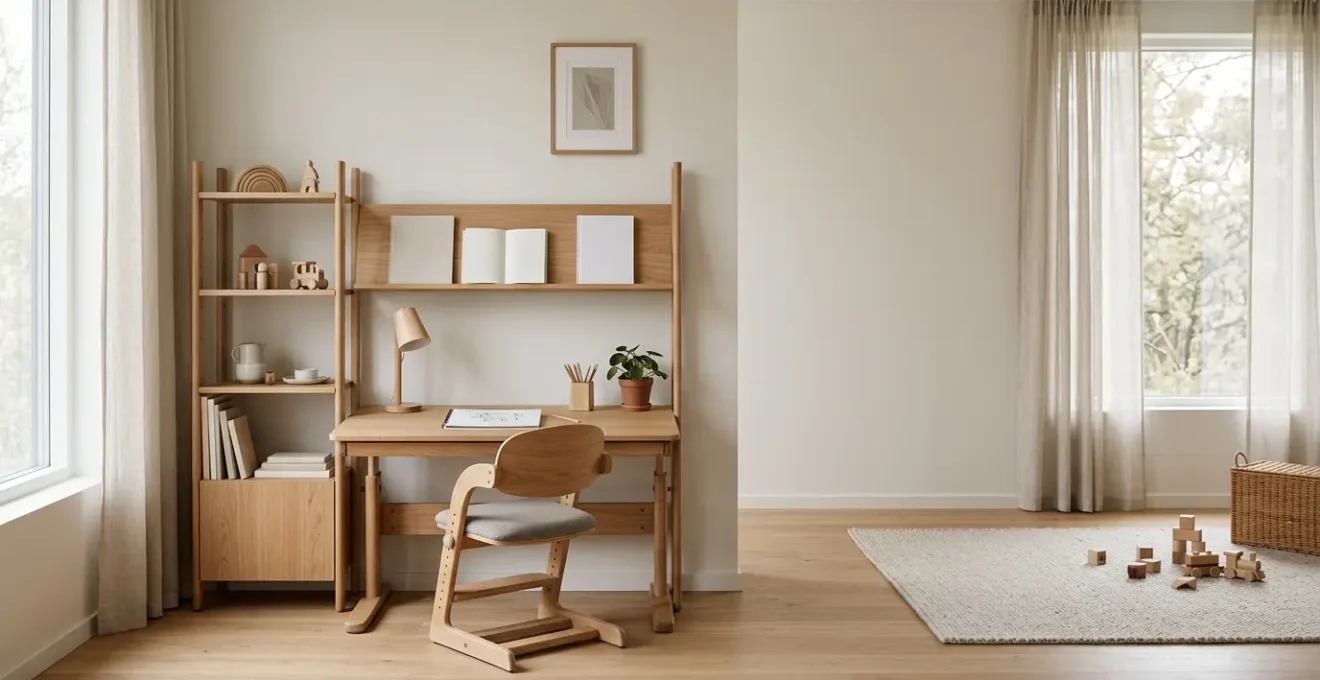
The true value of ergonomic furniture isn’t its adjustability, but its role as a long-term health system that prevents accumulating « postural debt » in a growing child.
- Cheap, non-repairable furniture often requires replacement within a child’s growth period, doubling the effective cost and compromising spinal health.
- True ergonomic support goes beyond a simple chair, involving adaptable storage and zoned living spaces that promote healthy habits like better sleep and creative play.
Recommendation: Invest in a solid wood modular system. Its durability and repairability provide a « repairability dividend » that ensures it can adapt to every stage of your child’s physical and cognitive development from age 5 to 18.
As a parent, you want to make smart, lasting investments for your child. When it comes to their primary workspace—the desk and chair where they’ll spend thousands of hours from their first doodles to their final exams—the promise of « grow with me » furniture seems like the perfect solution. The market is flooded with adjustable options, and many parents assume that as long as the height can be changed, the ergonomic box is ticked. This leads to a focus on finding the most affordable adjustable piece, believing a sound investment has been made.
However, this common approach often overlooks a critical factor: the accumulation of what I call postural debt. Cheaply made furniture, even if adjustable, often fails to provide adequate support, wears out quickly, and cannot be repaired. This forces parents into a cycle of replacement and can contribute to subtle but persistent postural problems that carry costs far beyond the price of a new desk. The conventional wisdom focuses on adjustability as a feature, but the real key to your child’s long-term health is viewing their furniture as an evolving ergonomic system.
This guide reframes the decision. We will move beyond the superficial appeal of « adjustable » and explore the true markers of a long-term ergonomic investment. We’ll analyze why the initial savings on cheaper furniture are a false economy, dissect the crucial difference in materials, and debunk common ergonomic myths. Ultimately, you’ll understand how to select a modular system that functions not just as furniture, but as a dedicated partner in your child’s healthy development for over a decade.
This article will guide you through the critical factors to consider, from material durability to the psychological benefits of a well-organized space. Let’s explore how to make a choice that supports your child’s spine, focus, and overall well-being for years to come.
Summary: The Definitive Guide to Choosing a Lifelong Ergonomic Furniture System
- Why Cheap « Grow With Me » Furniture Costs Double in the Long Run?
- Solid Wood vs Laminate: Which Survives Toddler Tantrums Better?
- How to Configure Modular Sofas for Sleepovers in Under 5 Minutes?
- The « Ball Chair » Myth: Why It Might Hurt Your Child’s Lower Back
- When to Expand Your Modular Shelving: Signs Your Storage Is Failing
- How to Cultivate a Harmonious Parenting Sanctuary in a Small Apartment?
- Improving Sleep Patterns: The Bedroom Setup That Cures Insomnia for Light Sleepers
- Screen-Free Parenting Activities: How to Engage a Bored 5-Year-Old for 60 Minutes?
Why Cheap « Grow With Me » Furniture Costs Double in the Long Run?
The initial price tag of a child’s desk and chair set can be deceptive. A lower upfront cost often masks significant long-term expenses, both financial and physical. The core issue lies in the planned obsolescence of budget materials. While you may be buying an « adjustable » piece, you’re likely investing in a system designed to fail within the very timeframe you need it to last. This creates a cycle of replacement that can easily double your initial outlay.
The fundamental problem is durability. An analysis of furniture materials shows that laminate pieces, often built on a particleboard core, have a typical lifespan of 5 to 12 years. A child’s journey from kindergarten to high school graduation spans 13 years. This means a cheap set purchased for a 5-year-old is statistically destined to fail before they finish middle school, forcing a second purchase. In contrast, solid wood furniture can last for decades, turning a single purchase into a genuine long-term asset. This growing awareness is reflected in market trends, with analysis projecting the ergonomic children’s furniture market to grow from USD 2,411 million in 2024 to over USD 5,598 million by 2034.
Beyond the direct replacement cost, there is the hidden expense of postural debt. Inadequately supported seating, wobbly surfaces, and poor ergonomic alignment force a child’s developing musculoskeletal system to compensate. This daily micro-strain accumulates over years, potentially leading to lower back pain, neck strain, and poor posture habits that require corrective therapies later in life. A quality ergonomic system is preventative care. By investing once in a durable, truly supportive system, you avoid paying twice: once for replacement furniture and again for addressing the health consequences of a poor initial choice.
Solid Wood vs Laminate: Which Survives Toddler Tantrums Better?
When considering furniture that must endure over a decade of use, from toddler scribbles to teenage angst, the material choice is paramount. The debate between solid wood and laminate isn’t just about aesthetics; it’s about the fundamental difference between a repairable asset and a disposable item. While laminate surfaces may initially resist scratches better, their fatal flaw is their inability to be repaired. Once the thin top layer is chipped, gouged, or peeling, the damage is permanent and often signals the end of the furniture’s life.
Solid wood, conversely, offers what I call a « repairability dividend. » It may show wear and tear more visibly in the short term—a scratch here, a dent there—but these are merely superficial wounds. As the Upphome Furniture Design Team notes, solid wood can be sanded and refinished to look new again, while damaged laminate cannot be repaired. This capacity for renewal is what gives solid wood its true longevity and makes it the superior investment for a 13-year+ timeline. A desk that can be fully restored after a childhood of « character-building » incidents is one that will see your child through to graduation.
This concept of repairability is central to a long-term investment mindset. The image below highlights the organic grain and texture of solid wood—a surface that tells a story and can be renewed, not just replaced. This tactile quality reinforces its value as a natural, durable material designed for a lifetime of use.

This ability to be restored makes solid wood uniquely suited to the unpredictable reality of family life. It doesn’t just survive tantrums and accidents; it has the built-in potential to recover from them completely. This makes it the only logical choice for a piece of furniture intended to be a single, long-term investment in a child’s environment. The higher initial cost is amortized over a much longer, more reliable service life.
How to Configure Modular Sofas for Sleepovers in Under 5 Minutes?
The versatility of modular furniture extends far beyond the desk and chair. For families, a modular sofa system can be a game-changer, transforming a living room into a play zone, a fort, or a comfortable guest bed for sleepovers. The key to unlocking this potential is efficiency. A complicated conversion process defeats the purpose. The goal is a sub-five-minute transformation from daytime lounge to nighttime haven, a feat easily achievable with the right system and a little planning.
The secret lies in simplicity and thoughtful design. Look for systems with lightweight yet sturdy components, high-friction bases that prevent slipping without complex connectors, and machine-washable covers. The process shouldn’t feel like a construction project but a swift rearrangement. By pre-planning a « sleepover layout » when you first acquire the furniture, you can ensure that only two or three core pieces need to be moved to create a spacious and stable sleeping surface.
Here is a practical, step-by-step guide to a rapid sleepover conversion:
- Pre-designate a ‘sleepover mode’ layout. When you first get the furniture, experiment and find the simplest configuration that creates a flat, stable bed. This ensures you know exactly which 2-3 pieces to move.
- Utilize stable, connector-free modules. Opt for pieces with high-friction bases or hidden sectional connectors that lock sections together with a simple push, providing stability without tools or effort.
- Create a central ‘accessory island’. Use ottomans and side pieces to form a separate area for snacks, drinks, and games, keeping the primary sleeping surface clean and dedicated to rest.
- Embrace multi-functional cushions. A well-designed system allows cushions to be rearranged from seating supports to flat mattress components or even fort walls in minutes.
- Prioritize easy-to-clean covers. Ensure all covers are machine-washable and simple to remove. This makes post-sleepover cleanup a stress-free task, not a dreaded chore.
This level of adaptability makes modular furniture an investment in your child’s social life as much as their physical comfort. It provides a fun, functional, and easily managed solution for one of childhood’s most cherished rituals.
The « Ball Chair » Myth: Why It Might Hurt Your Child’s Lower Back
In the search for ergonomic solutions, especially for active children, the stability ball chair is often touted as a panacea. The theory is that the unstable surface encourages « active sitting, » engaging core muscles and improving posture. However, from a pediatric ergonomic standpoint, this is a dangerous myth. While short-term use can increase postural awareness, prolonged sitting on a stability ball can actually create significant musculoskeletal strain and contribute to the very back pain it claims to prevent.
The problem lies in sustained muscle activation. To maintain balance on an unstable surface, the body’s core muscles, particularly the Psoas major, must remain constantly engaged. This isn’t the same as healthy, dynamic movement; it’s a state of low-level, chronic tension. Research has shown that this sustained effort can lead to Psoas muscle overactivation and tightness, which increases compression on the lumbar intervertebral discs. A clinical case study highlighted a professional who developed persistent lower back pain after six months of using a stability ball chair, a condition directly linked to Psoas tightness and pelvic misalignment from the constant balancing effort.
Furthermore, the core premise of improved stability and posture under prolonged use has been scientifically challenged. As researchers from Cornell University concluded in a key study:
The results of this study suggest that prolonged sitting on a dynamic, unstable seat surface does not significantly affect the magnitudes of muscle activation, spine posture, spine loads or overall spine stability.
– Gregory, Dunk, and Callaghan, Stability ball versus office chair
For a growing child, whose spine is still developing, the risks are even greater. The ideal ergonomic chair provides stable support, allowing muscles to relax while maintaining healthy spinal curves. It should feature adjustable seat height, seat depth, and, crucially, lumbar support to cradle the lower back. A stability ball offers none of these. It replaces a supportive structure with a demand for constant work, creating postural debt instead of preventing it.
When to Expand Your Modular Shelving: Signs Your Storage Is Failing
An often-overlooked aspect of a child’s ergonomic setup is storage. A desk and chair provide postural support, but the surrounding environment dictates workflow, focus, and independence. Modular shelving is the ideal solution because it can evolve alongside a child’s changing needs, from storing large toy bins for a 5-year-old to organizing textbooks and project supplies for a 15-year-old. The question is, when is it time to expand? The answer lies in observing the « failure points » of your current system.
The most common sign of failing storage is clutter. But not all clutter is the same. Floor piles typically indicate a lack of accessible, low-level storage that a child can easily reach. In contrast, surface stacks—piles on the desk, dresser, or nightstand—suggest a need for better vertical organization and compartmentalization. Each type of clutter is a diagnostic signal pointing to a specific inadequacy in the current shelving setup. Another clear sign is when you find yourself constantly mediating access to supplies or cleaning up projects because there’s no designated, protected space for work-in-progress items.
A truly ergonomic storage system is one a child can manage independently. The ultimate test is whether your child can complete the full cycle of retrieving an item, using it, and putting it away without assistance. If any part of this cycle breaks down, it’s a sign that the system is no longer scaled to their physical or developmental stage. It’s time to add modules that better match their current height, reach, and the nature of their activities.
Your Child’s Ergonomic Storage Audit
- Accessibility Check: Can your child independently reach and put away their most-used items without climbing or asking for help? If not, it’s time to add lower, more accessible modules.
- Project Protection: Are finished artworks or ongoing projects (like LEGO builds) being damaged due to a lack of safe, dedicated storage? Consider adding modules with doors or specific « project station » shelves.
- Clutter Diagnosis: Are there piles on the floor or stacks on surfaces? Floor piles signal a need for more low-level bins, while surface stacks require more vertical, compartmentalized shelving.
- Activity Shift: Has your child’s play evolved from large toys to smaller, more complex activities (e.g., model kits, craft supplies)? Expand with compartmentalized modules for better organization.
- The Full Cycle Test: Observe your child. Can they complete the entire « get, use, put away » cycle on their own? If they can’t, the system is failing and needs modification to support their independence.
How to Cultivate a Harmonious Parenting Sanctuary in a Small Apartment?
For families living in compact urban spaces, creating a sense of separation and calm can feel like an impossible challenge. The desire for an adult « sanctuary » often clashes with the reality of a child’s toys and activities spilling into every corner. This is where modular furniture, particularly open-back shelving, transcends its storage function and becomes a tool for creating spatial harmony. It allows for the creation of distinct zones without sacrificing light or a sense of openness.
Instead of building walls, you build boundaries. A tall, open-back modular shelving unit can act as a semi-transparent room divider. It visually separates an adult seating area from a child’s play zone, creating psychological distance while allowing light to flow through and maintaining a connection between the spaces. One side can be styled with minimalist decor for adult tranquility, while the child’s side can be configured with low, accessible bins for toys. This dual-purpose approach is driving significant growth in the furniture market, with the global kids’ furniture market valued at over USD 36.5 billion in 2024, largely due to demand for such multifunctional solutions.
This strategy is about curating distinct experiences within a shared environment. The visual below demonstrates how a modular divider creates balance, offering both separation and connection—the essence of a harmonious family space.
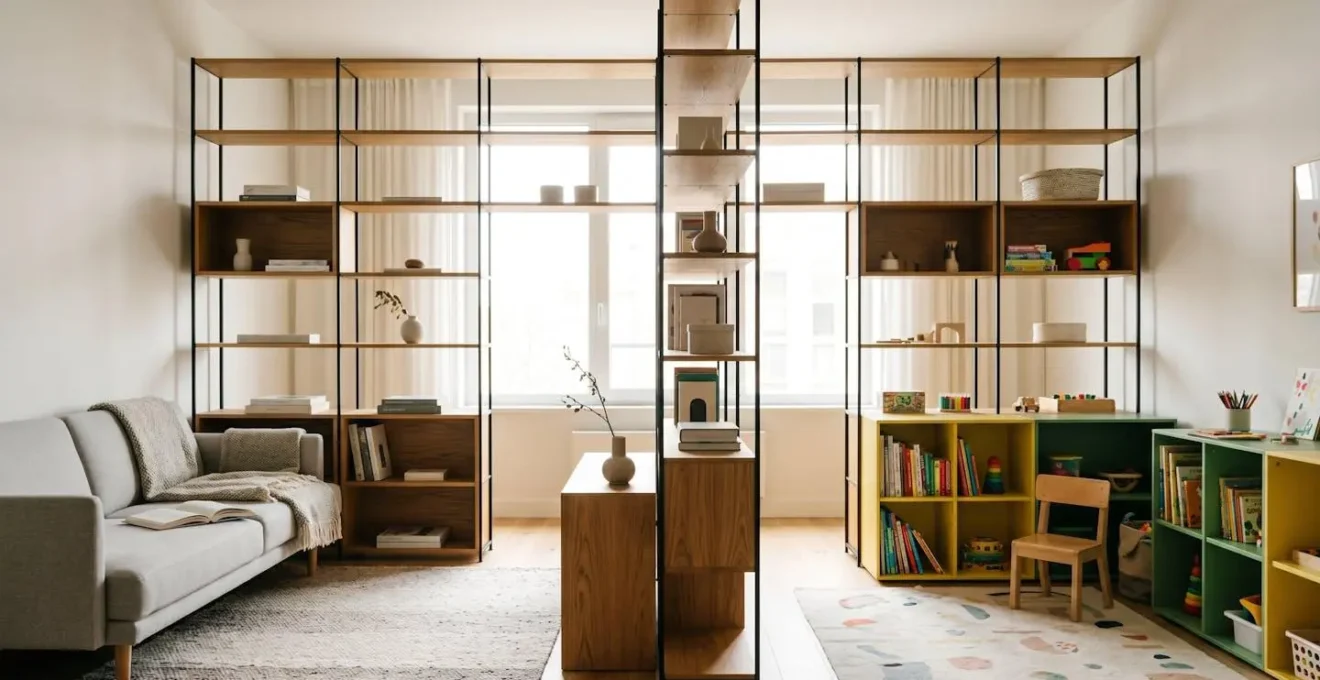
By using furniture to define function, you can cultivate a space that respects the needs of every family member. The adult area remains a calm refuge for conversation or relaxation, shielded from the visual chaos of playtime. Simultaneously, the child’s area becomes a clearly defined territory for their activities, which can help with containment and cleanup routines. It’s an investment in family well-being, proving that even in a small apartment, you don’t have to choose between a stylish home and a kid-friendly one.
Improving Sleep Patterns: The Bedroom Setup That Cures Insomnia for Light Sleepers
A good night’s sleep is foundational to a child’s health, mood, and cognitive function. For light sleepers, however, achieving restorative sleep can be a nightly battle. While parents often focus on routines and schedules, the physical environment of the bedroom plays a powerful, and often underestimated, role. Specifically, visual clutter is a significant saboteur of sleep quality. A cluttered room can contribute to anxiety and rumination, keeping the mind active when it should be winding down.
This isn’t just anecdotal; it’s backed by science. A 2017 study published in the journal Sleep found a direct correlation, showing that decluttering habits were a significant predictor of increased sleep quality. The study’s authors note that contextual cues, such as a messy room, may interfere with sleep by fueling a restless mind. For a child, this could mean that a bedroom filled with visible toys, clothes, and projects is actively working against their ability to fall and stay asleep.
This is where modular furniture with integrated storage becomes a critical tool for sleep hygiene. A modular bed frame with built-in under-bed drawers or a headboard that doubles as shelving can dramatically reduce visual clutter. By providing a designated, hidden home for every item, the bedroom transforms into a serene sanctuary dedicated solely to rest. Research on children’s sleep environments confirms this, showing that kids with higher-quality, clutter-free sleep spaces experienced shorter sleep latencies and longer sleep durations. The study specifically highlighted that modular bed systems with integrated storage help create the visually calm environment conducive to quality sleep.
Key Takeaways
- True ergonomic furniture is a long-term health system, not a single purchase; investing in durability and repairability prevents « postural debt. »
- Solid wood offers a « repairability dividend » that laminate lacks, making it the only material suitable for a 13+ year investment through childhood.
- Modular design extends beyond desks, creating spatial harmony in small homes and fostering vital developmental skills through screen-free, creative play.
Screen-Free Parenting Activities: How to Engage a Bored 5-Year-Old for 60 Minutes?
In an era dominated by screens, one of the greatest parenting challenges is fostering creative, hands-on play. The plea « I’m bored! » often sends parents scrambling for a solution, with digital devices being the easiest fix. However, the right physical environment can be a powerful antidote. Modular furniture, especially play couches and configurable cushions, is not just for sitting; it is a catalyst for imagination, transforming a living room into an endless landscape for screen-free adventure.
The magic of these systems lies in their simplicity and open-ended nature. Unlike a single-purpose toy, a set of modular cushions can become anything a child can imagine. This is powerfully captured in the experience of one parent:
The older kids love building forts, having furniture of their own and being able to sleep on it when they want to camp in the living room. We use it as extra seating, a bed for guests, to do yoga on… The cushions are thick enough to withstand multiple children sitting and climbing on it. So far I’ve had no downsides, it’s easy to use, had no chemical smell, it’s firm and well made.
– Parent Testimonial
This ability to transform is the key to sustained engagement. A simple set of modules can fuel an entire afternoon of activity, developing crucial skills along the way. Here are just a few ways to turn « I’m bored » into an hour of engaged, developmental play:
- Fort Construction: Using lightweight, uniformly sized cushions to build elaborate castles and tunnels develops spatial reasoning and engineering skills.
- Indoor Obstacle Course: Arranging sturdy modules as balancing beams, tunnels, and jumping « islands » is a fun way to improve gross motor skills and coordination.
- Imaginative Play Scenarios: Reconfiguring pieces into a car, a spaceship, a shop counter, or a puppet stage encourages role-playing, storytelling, and social interaction.
- Building Challenges: Timing a child to create a specific structure, like a bridge or a chair, turns play into a game that hones problem-solving and creative thinking.
By investing in these versatile tools, you are not just buying furniture; you are investing in a platform for creativity that will pay dividends in your child’s development for years.
Choosing the right furniture for your child is one of the most impactful long-term health decisions you can make as a parent. By shifting your perspective from a one-time purchase to an evolving ergonomic system, you move beyond the false economy of cheap, disposable products. An investment in a durable, repairable, and truly modular system is an investment in preventing postural debt, fostering good habits, and supporting every stage of your child’s physical and cognitive journey. Now is the time to evaluate your home environment not just for what it is, but for what it could be: a seamless ecosystem that promotes health, creativity, and harmony for the entire family. For parents ready to make this strategic investment, the next logical step is to analyze your specific needs against this comprehensive framework.