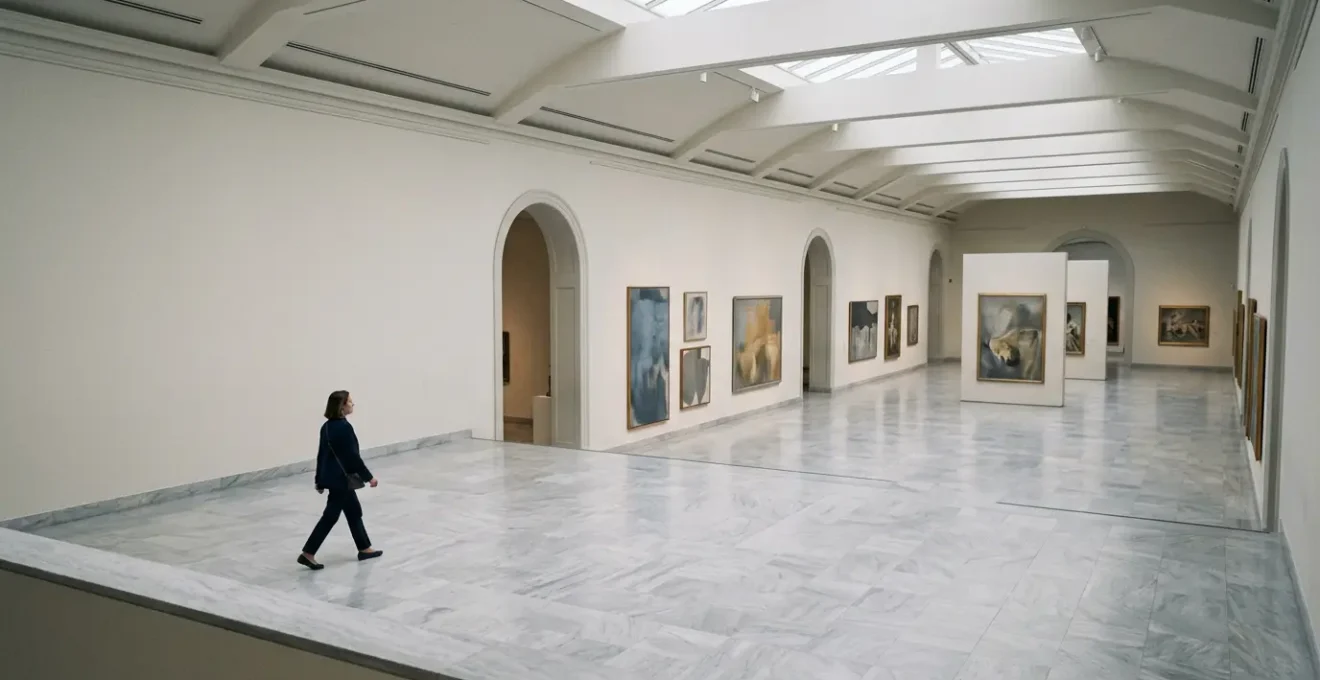
The key to conquering museum fatigue is not to see less, but to see with intention, transforming your visit by adopting a curator’s selective mindset.
- Instead of passively consuming, you must actively choose what to engage with and, more importantly, what to ignore.
- This means abandoning the goal of « seeing everything » and embracing the goal of having a few profound encounters with art.
Recommendation: Before your next visit, select just three to five « must-see » galleries or artworks and build your entire route around them, allowing for spontaneous discovery in between.
The feeling is universally familiar to anyone who has stepped into a world-class institution like the Louvre or the Metropolitan Museum of Art. You enter with excitement, and within 90 minutes, a profound weariness sets in. Your feet ache, your eyes glaze over, and the Titians and Turners begin to blur into a single, overwhelming mass of color. This is « museum fatigue, » a cognitive and physical exhaustion that can turn a cultural pilgrimage into a grueling chore. Conventional wisdom offers simple advice: plan your visit, take breaks, don’t try to see it all. But these tips only address the symptoms, not the root cause.
The real issue isn’t the size of the museum; it’s our mindset as visitors. We often approach these spaces with a passive, completist attitude, as if we’re trying to binge-watch a series on an impossible deadline. But what if the secret to a better experience wasn’t about time management, but about a fundamental shift in perspective? What if, instead of behaving like a tourist, you started thinking like a curator? Adopting a curatorial mindset means making deliberate, even ruthless, choices to prioritize deep engagement over broad coverage. It’s about filtering your experience to protect your attention and amplify your appreciation.
This guide is built on that single, transformative idea. We will deconstruct the common traps that lead to fatigue and provide a strategic framework to help you curate your own unforgettable journey. From choosing the right path through the galleries to decoding the art on a deeper level, you will learn how to navigate these vast collections with purpose and leave feeling inspired, not exhausted.
Table of Contents: A Curated Path to Beating Museum Fatigue
- Top-Down vs Bottom-Up: Which Route Avoids the Bottlenecks?
- Official Audio Guide vs Spotify Playlists: Which Is Better for Immersion?
- Why Reading Every Placard Destroys Your Appreciation of the Art?
- The « Cleaned » Painting Controversy: Noticing Restoration Details
- When to Visit the Mona Lisa: The One Hour Slot That Is Actually Bearable?
- How to Experience Paris Gastronomy and Culture on a Budget During Fashion Week?
- Visiting Cultural Heritage Centers: How to Make History Interesting for Teenagers?
- How to Experience Paris Gastronomy and Culture on a Budget During Fashion Week?
Top-Down vs Bottom-Up: Which Route Avoids the Bottlenecks?
Every museum visit begins with a choice, often an unconscious one, about your route. The « Bottom-Up » approach is the default for most visitors: you start at the beginning (e.g., Antiquities) and proceed chronologically or geographically until your energy gives out, usually somewhere in the 17th-century Dutch masters. This method guarantees you see the early parts of the collection but almost ensures you’ll be too exhausted for the Impressionists or modern wings, which are often the main draw.
The « Top-Down » approach is the exact opposite. You make a beeline for the museum’s greatest hits—the Mona Lisa, the Winged Victory, The Night Watch—and then, if you have any energy left, you wander the adjacent galleries. While efficient for ticking off a checklist, this strategy often involves battling the largest crowds and reduces the visit to a series of trophy hunts, leaving little room for personal discovery.
A true curatorial strategy rejects both extremes in favor of a « Curated Path. » This involves identifying three to five key artworks or galleries that you are genuinely excited about, regardless of their fame or location. You then plot the most efficient route between these anchor points. The spaces you traverse between your chosen highlights become opportunities for spontaneous discovery. You are no longer a slave to chronology or crowd dynamics; you are following your own intellectual and aesthetic curiosity. This intentional navigation is the first step in taking control of your experience and preventing the aimless wandering that so quickly drains your mental battery.
By defining your own narrative through the museum, you transform a potentially overwhelming space into a personalized journey, ensuring your energy is spent on what matters most to you.
Official Audio Guide vs Spotify Playlists: Which Is Better for Immersion?
The right audio can transform your museum visit from a silent walk into a rich, narrative experience. The traditional choice is the museum’s official audio guide. However, the rise of custom Spotify playlists and podcasts offers a compelling alternative. The question isn’t simply which platform is better, but which format best serves the goal of intentional engagement. Official guides are often dry, scripted monologues, delivering facts but rarely sparking curiosity.
A more immersive audio experience is one that feels like a conversation. This is where both high-quality podcasts and the best modern audio guides excel. They move beyond simple descriptions to offer interpretation, storytelling, and connections to broader themes. Research has shown the power of this approach. A study on museum audio tours found that visitors using guides with spontaneous, interactive dialogue between two curators engaged far more with the art. According to the study on conversational guides, visitors produced 35 on-topic conversational turns per painting, compared to just 20 with traditional scripted guides.

As this visitor demonstrates, the goal is absorption, not just information. Whether you find a « Museum-Worthy » playlist on Spotify or invest in a well-produced guide, the key is to choose content that sparks your imagination rather than just listing dates and dimensions. A good audio companion should feel like you’re walking through the gallery with a fascinating, knowledgeable friend who knows when to talk and, just as importantly, when to be quiet and let you look.
Case Study: Spontaneous Dialogue vs. Scripted Monologue
Researchers tested museum audio tours featuring spontaneous interactive dialogue between two curators versus traditional scripted monologues. Visitors using the spontaneous dialogue guides were far more engaged, producing significantly more on-topic conversational turns with their companions. This conversational format fostered a more enjoyable and immersive experience, proving that the style of delivery is more critical than the device it’s played on.
Ultimately, the best tool is the one that helps you connect personally with the art, turning a passive viewing into an active, thought-provoking dialogue.
Why Reading Every Placard Destroys Your Appreciation of the Art?
It feels like the diligent, correct thing to do: you approach a painting and immediately turn to the small rectangular placard next to it. You read the title, the artist, the date, and the descriptive paragraph. Only then do you look at the art. This habit, while well-intentioned, is one of the primary drivers of museum fatigue. The constant shifting of focus from visual analysis (the painting) to verbal processing (the text) creates a significant cognitive load, draining your mental energy with every artwork you see.

Your brain is being asked to perform two very different tasks simultaneously. First, look and feel. Second, read and analyze. Doing this for dozens or hundreds of artworks is exhausting. Museum professionals are aware of this; best practices suggest limiting placard text to 50 to 150 words, but even this can be too much when repeated ad nauseam. The curatorial approach flips the script: look first, read later. Spend one to two full minutes just looking at the artwork. Let your eyes wander. What do you notice? What is the feeling? What story does it tell you *before* you know the « official » one? Only after you have formed your own initial impression should you glance at the placard—and only to answer specific questions that arose during your observation (e.g., « I wonder when this was made? »).
Designers can more effectively structure visual hierarchies, enhance cueing, and reduce extraneous cognitive load, thereby improving the clarity, accessibility, and educational impact of museum displays.
– Research team on cognitive style and visual attention, MDPI study on multimodal museum exhibitions using eye-tracking
As experts confirm, reducing « extraneous cognitive load » is key. By treating the placard as a supplemental resource rather than a mandatory starting point, you preserve your most valuable asset: your visual and emotional attention. You allow for a personal connection with the art, which is infinitely more memorable and rewarding than simply accumulating facts.
This simple shift in behavior is one of the most powerful tools for transforming your museum experience from exhausting to exhilarating.
The « Cleaned » Painting Controversy: Noticing Restoration Details
One of the most effective ways to shift from a passive viewer to an active participant is to play detective. Instead of just looking at what a painting depicts, start looking at the painting as a physical object with a history. A fascinating and accessible way to do this is to look for signs of restoration. Art restoration is a controversial field, delicately balancing between preservation and alteration. For the visitor, it offers a trail of clues into a work’s past.
Often, a « cleaned » painting will have shockingly vibrant colors next to areas that remain more muted, or a surface gloss that seems inconsistent. These are not flaws; they are historical records. Noticing them turns your visit into an investigation. You start asking questions: « Why was this part cleaned and not that one? What did it look like before? » This active inquiry is the enemy of museum fatigue. It engages your analytical mind in a way that is energizing, not draining.
Case Study: The Sistine Chapel Restoration Controversy (1980-1994)
The massive restoration of Michelangelo’s Sistine Chapel ceiling revealed incredibly vibrant colors that had been hidden under centuries of soot. However, the project was immediately controversial. Critics and art historians argued that the aggressive chemical cleaning stripped away Michelangelo’s final layers of subtle shadowing (a technique called chiaroscuro), permanently flattening the intended depth and texture. This famous case highlights the fine line restorers walk and serves as a powerful reminder that what we see today is not always what the artist originally intended.
This critical perspective is essential. As one analysis on the ethics of restoration notes, there’s often a motive beyond pure preservation. This knowledge empowers you to look with a more discerning eye.
Authorities at the National Gallery have themselves confessed that a great number of cleanings are done to make the paintings more attractive rather than to restore the original work.
– O’Riordan cited in restoration ethics study, University of Notre Dame essay on art restoration ethicality
By learning to spot these details, you are no longer just looking at a picture; you are reading a story of survival, science, and sometimes, controversy. It’s a skill that makes every museum visit richer.
Your Action Plan: How to Spot Restoration Details
- Look for color inconsistencies: Compare brightness and saturation across different sections of a large painting to identify recently restored versus untouched areas.
- Examine surface texture variations: Observe whether certain portions appear flatter or more opaque, potentially indicating modern intervention versus original brushwork.
- Study the craquelure patterns: Examine the network of age cracks in the paint film; uniform or reduced cracking in specific areas may signal restoration.
- Notice varnish differences: Check for variations in surface gloss or yellowing that might reveal whether sections were cleaned at different times or to different degrees.
- Use your phone camera zoom: Employ your device’s magnification feature as a ‘detective’s magnifying glass’ to inspect fine details invisible to the naked eye from behind barriers.
Turning your visit into a treasure hunt for historical interventions is a guaranteed way to keep your mind sharp and engaged from the first gallery to the last.
When to Visit the Mona Lisa: The One Hour Slot That Is Actually Bearable?
Few experiences in the art world are as universally underwhelming as seeing the Mona Lisa. The reality is a distant, small painting, encased in glass, and obscured by a thicket of raised smartphones. This is a classic case of a « bottleneck » artwork, where the fame of the piece creates an environment antithetical to its appreciation. The curatorial mindset demands a strategic approach to such situations: either find a way to make the experience bearable or consciously decide to skip it.
If you must see her, timing is everything. The worst times are midday and weekends. The best-kept secret for the Louvre is often the Wednesday or Friday evening hours, specifically in the last 60-90 minutes before closing. The day-trippers have left, and the crowds thin dramatically. Your goal is to catch the tail end of the « crowding-out effect. » An MIT SENSEable City Lab study on Louvre visitor flow confirmed a paradox: while dense crowds initially attract more people to a location, extreme overcrowding eventually dissuades visitors from staying. By arriving as this effect peaks, you benefit from the subsequent dispersal.
However, an even more advanced curatorial move is to use the Mona Lisa as a diversion. While the majority of visitors are packed into that one room, entire wings of the museum are left blissfully empty. While they fight for a selfie, you could have a whole gallery of magnificent Rubens or Delacroix paintings almost to yourself. The most rewarding strategy is often to find the museum’s own « zones of respite, » places intentionally designed to combat fatigue.
Case Study: Princeton University Art Museum’s Design to Combat Fatigue
When redesigning their building, architects at the Princeton University Art Museum specifically aimed to ‘combat visitor fatigue.’ They employed several methods: dynamic shifts in gallery size to prevent monotony, large windows providing « lens moments » for visual breaks, and dedicated « respite rooms » with minimal installations (a maximum of three artworks) and comfortable benches. This shows that institutions are actively thinking about how to solve the problem of fatigue through smart design, a feature discerning visitors can learn to seek out.
Ultimately, the choice is yours: brave the crowds with smart timing, or use the crowd’s behavior to your advantage by exploring the tranquil, forgotten corners of a great museum.
How to Experience Paris Gastronomy and Culture on a Budget During Fashion Week?
The principles of curating a museum visit—avoiding bottlenecks, seeking authenticity, and prioritizing personal engagement—apply perfectly to navigating a city, especially a city as dense with culture and tourist traps as Paris. Thinking about experiencing its gastronomy on a budget during the chaos of Fashion Week is an excellent real-world application of the curatorial mindset.
First, identify the « Mona Lisas » of Parisian dining: the famous cafés and restaurants lining the Champs-Élysées or clustered around the Eiffel Tower. Like the famous painting, they offer a predictable experience at a high cost (both in money and in time spent waiting). A curator of their own trip would consciously avoid these bottlenecks. Instead, they would apply the « Curated Path » principle. They would research and identify a few « anchor » experiences in less-touristy arrondissements—a specific bakery renowned for its kouign-amann, a fromagerie with a passionate owner, or a small bistro with a stellar plat du jour.
The « Bottom-Up » approach to Parisian food is eating at the first tourist menu you see. The « Top-Down » is booking a three-star Michelin restaurant. The curated path is different. It’s about finding the « gallery of Rubens » that everyone else is ignoring: the vibrant, authentic food markets like Marché d’Aligre or Marché des Enfants Rouges. Here, you can assemble a world-class picnic of cheese, charcuterie, and bread for a fraction of the cost of a sit-down meal. This is the gastronomic equivalent of finding a quiet wing in the Louvre. It requires a little more research, but the reward is a far more authentic, enjoyable, and affordable experience, even amidst the city’s most hectic week.
By treating the city’s culinary landscape like a massive, delicious museum, you can filter out the noise and discover the true masterpieces.
Visiting Cultural Heritage Centers: How to Make History Interesting for Teenagers?
There is perhaps no tougher audience to curate for than a teenager at a historical site. Their infamous disinterest, however, provides the ultimate lesson in engagement—a lesson we can apply to ourselves when facing museum fatigue. If you can make a cultural heritage center interesting for a teenager, you have mastered the art of intentional engagement. The secret is not to force-feed them facts, but to find a personal point of connection.
First, abandon the « Bottom-Up » chronological tour. It’s the equivalent of a death march. Instead, adopt a « Top-Down » narrative approach. Before you even arrive, find one or two genuinely fascinating, weird, or gruesome stories associated with the site. Was there a dramatic escape? A notorious villain? A scientific mystery? Start with the story, not the artifacts. This is the curatorial skill of creating a « special exhibition » from a permanent collection. You are framing the visit around a compelling plot.
Second, leverage the « Look First, Read Later » principle. Instead of directing them to a placard, ask engaging questions. « If you could only save one object from a fire, which one would it be and why? » or « This technology is 200 years old. What in your life does the same job today? » This transforms them from passive observers into active problem-solvers. It’s the same technique we should use on ourselves: asking personal, imaginative questions of the art before us. The goal is to connect the historical « then » with a personal « now, » making history feel relevant rather than remote. By curating the experience around story and personal connection, you’re not just making it bearable; you’re making it memorable.
Ultimately, making history interesting for a teenager—or for our own fatigued brain—is about finding the human story within the collection and connecting it to our own.
Key Takeaways
- Adopt a « Curatorial Mindset »: Actively choose your experience rather than passively consuming the entire museum.
- Prioritize Engagement Over Coverage: A deep connection with a few artworks is more rewarding than a shallow look at hundreds.
- Use Bottlenecks to Your Advantage: While crowds flock to famous pieces, explore and enjoy the blissfully empty galleries nearby.
How to Experience Paris Gastronomy and Culture on a Budget During Fashion Week?
This title, appearing a second time, presents a deeper challenge—one of constraint. Experiencing Paris during Fashion Week on a budget is not just about avoiding crowds, but about thriving within limitations. This scenario is the ultimate test of a curatorial mindset, proving the thesis that scarcity is the mother of good curation. When time, money, and access are limited, you are forced to make better, more creative choices.
During Fashion Week, the city’s resources are stretched thin. Restaurant reservations are impossible, and prices for everything are inflated. A passive visitor will be met with frustration and closed doors. But a curator sees constraint as a clarifying filter. A tight budget makes the tourist-trap brasserie on the corner impossible, forcing you to discover the local boulangerie for a jambon-beurre sandwich that is not only cheaper but also a more authentic Parisian experience. The inability to get a dinner reservation encourages you to explore the city’s incredible street food scene or its neighborhood markets for a picnic along the Seine.
This principle extends directly to a museum visit under a time constraint. Having only 90 minutes is not a curse; it is a gift. It makes the « see everything » approach impossible, forcing you to ask the most important curatorial question: « What is truly essential for *me* to see? » This imposed scarcity forces you to define your priorities, to create a « Curated Path » not as a theoretical exercise, but as a practical necessity. It strips away the illusion of unlimited time and focuses your attention on what is most valuable. The pressure of Fashion Week, or a ticking clock in a museum, compels you to edit your experience down to its most meaningful essence.
Apply this curatorial mindset to your next museum visit. Embrace your limitations, make deliberate choices, and you will transform a potentially overwhelming day into a deeply personal and rewarding journey.